Emerging markets are not what they used to be, neither should their allocation
For decades, investing in emerging markets (EMs) followed a predictable playbook: Track local politics and economies, commodity cycles and identify companies with the potential to succeed either in global export markets or fast-growing domestic markets. But over the past three years, that playbook has been fundamentally reshaped by the explosive growth in AI semiconductors and the surge in AI-related infrastructure spending.
The US dominates the market of top-performance chip design through companies like Nvidia, AMD, as well as increasingly through in-house chip design by major semiconductor buyers like Google or Amazon, which are developing their own in-house AI accelerators. On the other hand, emerging markets are home to the vast supply chain that these companies rely on. Regardless of which US company designs the leading-edge chip, it is, with few exceptions, manufactured by TSMC in Taiwan. One exception is Samsung, whose smaller semiconductor foundry business is also based in an emerging market. Another is Intel, which still maintains its own manufacturing capabilities but has increasingly shifted some production orders to TSMC in recent years to remain competitive.
Emerging Asia’s presence is however not limited just to chip manufacturing; it only starts there. Taiwan, Korea and China offer an ecosystem of companies with leadership in majority of components found in AI servers, from memory, printed circuit boards, cooling, power supply units and other components to final design and assembly of AI servers.
This reliance on AI infrastructure from emerging Asia has transformed sectoral weightings and EM’s growth profile and subsequently return profile. The tech weighting in MSCI Emerging Market Index is 36.8%, which is larger than the tech weighting of the S&P500 at 35%. EMs are now seeing earnings boom they haven’t seen in the last 20 years (with the exception of rapid earnings recovery in 2010 after the 2009 shock so not a fair comparison) and this earnings growth is translating into returns. EMs are finally outperforming developed markets after a very long time of lagging returns. Last year, MSCI EM Index cumulatively returned 52.9%, beating both MSCI AC World at 30.4% and the Nasdaq at 29.9%. The same patterns continue year – to- date.*
*Source: FactSet / MSCI, as at 30 May 2026.
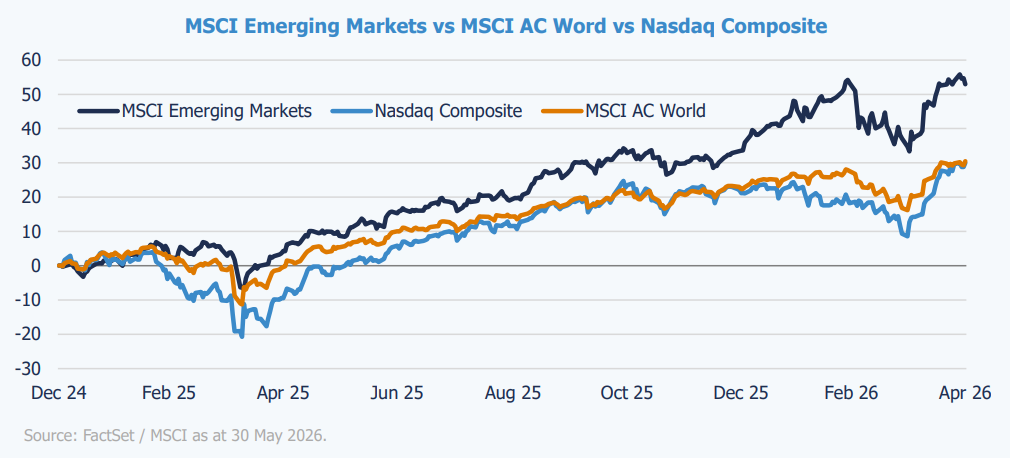
This outperformance is not simply the result of slightly higher technology weightings, but also of a fundamentally different type of exposure within the technology sector itself. While both the US market and emerging markets provide exposure to AI, a large share of US technology is concentrated in companies spending heavily on AI, such as Alphabet, Amazon, Meta, and Microsoft, where investors have increasingly questioned the returns on these massive investments. Another large portion of US tech footprint is in software companies, but these face the risk that rapidly advancing AI capabilities could disrupt their existing business models.
On the other hand, tech companies in EMs rather present picks and shovels of the AI revolution. While fierce competition to develop leading AI models has weighed on investor enthusiasm for US hyperscalers, the resulting surge in capital expenditure has been a major tailwind for the “picks and shovels” companies in emerging markets that supply the underlying AI infrastructure.
This divergence in AI exposure is likely to become even more pronounced following the eventual IPOs of companies such as OpenAI and Anthropic. Increasingly, the question of whether emerging markets can outperform the US market may come down to where the greater economic returns from the AI boom ultimately accrue: to the companies spending on AI infrastructure, or to the companies enabling it.
Despite the exceptional performance of emerging markets so far this year, returns have been heavily concentrated. Around 60% of the gains in the MSCI EM Index have been driven by just three stocks, TSMC, Samsung Electronics, and SK Hynix.
That said, it would be a mistake to view the EM technology opportunity as being limited to these mega-cap names alone. Active portfolio managers continue to have access to a broad and diverse opportunity set across the EM tech ecosystem. As discussed earlier, emerging Asia is home to numerous global leaders supplying critical components for AI servers. Many of these companies are well positioned to benefit from rising dollar content as future AI accelerator platforms have and will drive increasingly demanding technology upgrades to support ever-higher computing power requirements.
AI has reshaped how asset allocators should think about emerging markets. Beyond their traditional cyclical characteristics, emerging markets now offer critical and often irreplaceable technology exposure through a deep ecosystem of companies underpinning the AI infrastructure value chain.
While market performance this year has been heavily concentrated in a handful of mega-cap names, it would be a mistake to view EM technology solely through that lens. The large pool of EM companies in the AI supply chain creates a broad and evolving opportunity set for active investment managers, whose ability to identify these structural winners early may leave them better positioned to capitalise on this regime change than passive investment strategies.
Professional investors only .
This is a marketing communication .
Issued and approved in the UK by J O Hambro Capital Management Limited (“JOHCML”) which is authorised and regulated by the Financial Conduct Authority. Registered office: Level 3, 1 St James’s Market, London SW1Y 4AH. Issued in the European Union by Perpetual Investment Services Europe Limited (“PISEL”) which is authorised by the Central Bank of Ireland. Registered office: 24 Fitzwilliam Place, Dublin 2, Ireland D02 T296. Issued in the United States by JOHCM (USA) Inc. (“JOHCMU”). Principal office: One Congress Street, Suite 3101, Boston, Massachusetts 02114. Issued in Singapore by JOHCM (Singapore) Pte Limited (“JOHCMS”) which is regulated by the Monetary Authority of Singapore. Registered office: 138 Market Street, #15 04 CapitaGreen, Singapore 048946. References to “JOHCM” below are to JOHCML, JOHCMU, JOHCMS or PISEL as the context requires. Perpetual Group is a trading name of JOHCML and PISEL .
RISK CONSIDERATIONS: The strategy invests in international and emerging markets. International investments involve special risks, including currency fluctuation, lower liquidity, different accounting methods and economic and political systems, and higher transaction costs. These risks typically are greater in emerging markets. Such risks include new and rapidly changing political and economic structures, which may cause instability; underdeveloped securities markets; and higher likelihood of high levels of inflation, deflation or currency devaluations .
The views expressed are those of the portfolio manager as the date of posting, are subject to change, and may differ from the views of other portfolio managers or the firm as a whole. These opinions are not intended to be a forecast of future events, a guarantee of future results, or investment advice.
The distribution of this document in jurisdictions other than those referred to above may be restricted by law (“Restricted Jurisdictions”). Therefore, this document is not intended for distribution in any Restricted Jurisdiction and should not be passed on or copied to any person in such a jurisdiction .
Past performance is no guarantee of future performance. The value of an investment and the income from it can fall as well as rise as a result of market and currency fluctuations and you may not get back the amount originally invested .
Investing in companies in emerging markets involves higher risk than investing in established economies or securities markets. Emerging markets may have less stable legal and political systems, which could affect the safe-keeping or value of assets .
Investments may include shares in small-cap companies and these tend to be traded less frequently and in lower volumes than larger companies making them potentially less liquid and more volatile .
The information contained herein including any expression of opinion is for information purposes only and is given on the understanding that it is not a recommendation .
The information in this document does not constitute, or form part of, any offer to sell or issue, or any solicitation of an offer to purchase or subscribe for any funds or strategies described in this document; nor shall this document, or any part of it, or the fact of its distribution form the basis of, or be relied on, in connection with any contract .
Telephone calls to and from JOHCM may be recorded. Information on how personal data is handled can be found in the JOHCM Privacy Statement on its website: www.johcm.com
J O Hambro® and JOHCM® are registered trademarks of JOHCML.


How can we help?
From our very first conversation to ongoing support, our teams of experts are here to answer your investment needs.