

JOHCM Asia Ex Japan Strategy
Size
GBP 201.80m
Momentum, yen/$ carry trades and crowded thematic rotations revealed a dangerous fragility in global markets in August. The volatility subsided fairly quickly but was it a sign of deeper trends that we should make an effort to understand.
False narratives create opportunity
Markets currently are driven by a confluence of forces beyond the traditional appraisal of macroeconomics. Leveraged momentum plays seem to have created crosscurrents of unstable correlations. In August, the inference of a US recession came only because of the collapse in bond yields and, so far, hasn’t been backed by hard data. In effect, the moves in the market wrote an economic narrative with potentially false conclusions.
We can’t predict what might happen to the US economy, whether the Federal Reserve will cut rates, or who will be their next President. What we do believe is that the market moves might have created a false set of narratives. We believe that these have been built not on compelling economics, but on extrapolations from jarring moves in the bond yields, currencies and stock prices.
Our view is that this represents an opportunity for patient investors looking for attractive entry points that go beyond fickle momentum trades.
The case for Asia ex-Japan
Valuations do make Asian stocks a contrarian opportunity. Yet, over the past few years, there are several transformations under the hood such as:
In India, political stability, a geopolitical ‘sweet spot’, government policies encouraging manufacturing investments and stellar capital deployment by companies is a heady mix crystalising the latent structural growth potential. Earnings growth in India is broad based, while new business formation is ticking up. Risks revolve around valuations (above mean) and disruptions from either AI or increased protectionism in the world.
India’s mutual fund industry has done a stellar job in persuading its population to invest systematically in monthly savings plans. Dollar cost averaging has extended in reach well beyond the top 30 cities even as the total flows have increased dramatically. Of course, the bull market has fed on itself, but is one of the reasons for Indian companies sustaining high valuations.
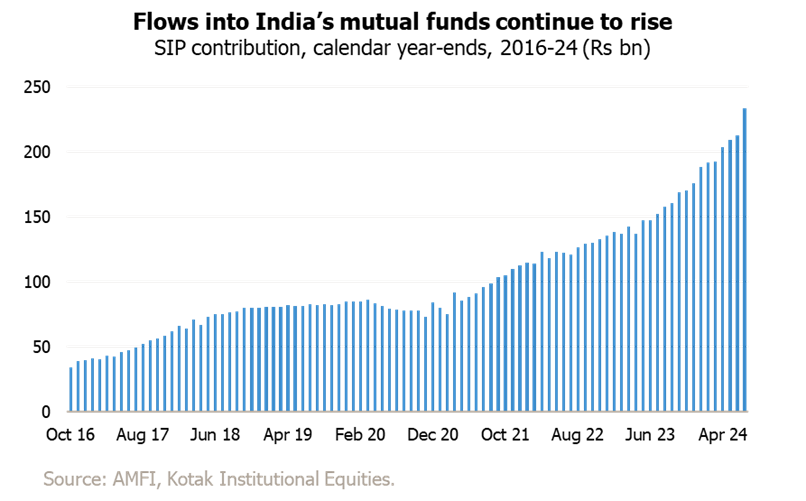
India’s other long-term pool of capital is the insurance sector, growing rapidly and consistently deploying capital. Stock valuations can appear high but this local pool of capital acts as a buffer from big drawdowns. A confluence of good macroeconomic events is helping many businesses scale up with a long runway for sustained growth.
The ‘current big thing’: artificial intelligence (AI), has profound implications across businesses. In Asia, in my opinion, we could witness a replacement cycle for technology hardware with newer devices enabled for AI. Importantly, we might witness a return of pricing power for hardware manufacturers; a dramatic change from the trend over the past two decades. Taiwan’s geopolitical challenges remain in the spotlight, but its technology hardware expertise gives it real competitive advantages.
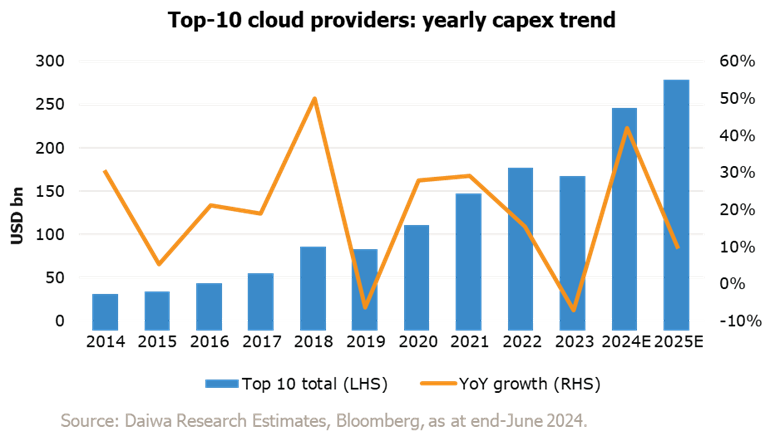
This chart above represents spending by just the top 10 cloud service providers. Taiwan in specific and Asian hardware manufactures in general could continue benefiting from the follow through spends by end users. Corporates and consumers will likely buy a plethora of devices with AI enables features. This trend of replacement could last well over 3-5 years and importantly will provide higher average selling prices for complex hardware.
Markets perennially debate Federal Reserve’s monetary policies. Increasingly there is consensus on rate cuts – this can never be taken as gospel truth since many such predictions have fallen by the wayside. Yet, if the Federal Reserve does cut rates over the next 12-18 months, the US$ will likely depreciate. That will be hugely beneficial to Asian equities. Even for Chinese equities, which currently lack any semblance of enthusiasm.
At least China’s problems are no longer a surprise
Geopolitical realignment away from China is no longer a surprise. Constraints imposed against China and its resultant economic problems are well telegraphed. An economy which is in a self-imposed slowdown to deflate various bubbles and moderate leverage, has poor trends on several economic metrics. Geopolitical differences, trade wars, bursting of the property bubble and investor apathy has manifest in poor performance of the Chinese stock market. Even relative to emerging markets Chinese stocks have fared poorly.
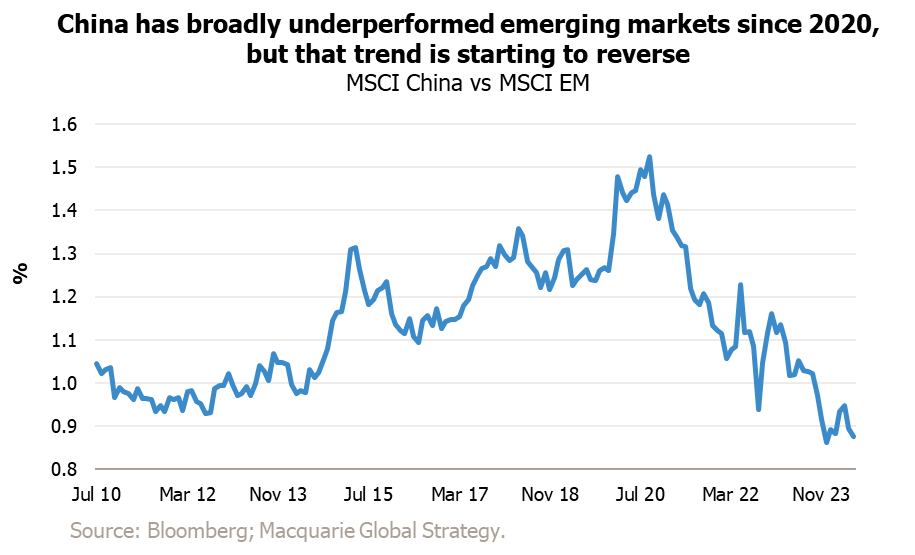
Most investors would have already sold or reduced exposure to Chinese equities. That should be looked at positively; China’s problems are no longer a big surprise. In my view, it’s highly unlikely that China’s market will face further massive drawdowns. Meanwhile, a select group of companies are generating copious amounts of cash and returning that to minority shareholders. For any portfolio, this provides a good contrarian allocation.
Companies have already recalibrated operations in this changed geopolitical world. Contingency plans for further tariffs are formulated too. If the effects of the geopolitical rivalry rachet higher under a new US administration, the effect on US and European businesses is likely to be far greater than on China itself; the valuations of some of those businesses have more to lose.
In ASEAN, the geopolitical strife and trade wars have resulted in new business models and new investments benefiting from China Plus One (a strategy to avoid investing only in China, encouraging diversification of manufacturing into other countries). This is translating to growth in earnings.
Valuations are supportive and earnings improving
As allocators of capital, we think Asia is one of the best regions to invest over the next three to five years. Should the US$ weaken, Asian equities could be turbocharged.
No doubt, in the event of a US slowdown or a recession, Asia will not be immune. However, markets are made at the margin; valuations are supportive, and there is evidence of a broadening improvement in earnings.
Asia-ex Japan may be unpopular, but a cheap and neglected asset class with improving earnings and the potential to benefit from liquidity flows catches our attention.
We have a good balance in the portfolio as we try to capture earnings growth, structural trends and durable themes.

From our very first conversation to ongoing support, our teams of experts are here to answer your investment needs.