
JOHCM UK Equity Income Strategy
Size
GBP 2.16bn

The ongoing hostilities in the Middle East have had meaningful impacts on markets, economic growth and potentially monetary and fiscal policies across the world. The Brent oil price was almost 60% higher during the month and many oil related products such as jet fuel saw even sharper increases. If the conflict continues, availability of product may become an issue, with some airlines, for example, already beginning to curtail schedules. Notably, oil prices further along the curve saw much more measured increases, with 5-year Brent currently sitting at around $71 compared to spot at $115 (source: Bloomberg as at 1 April 2026), as markets factored in a normalisation of flows at some stage, and possibly the acceptance of Iranian oil, under a new regime, into the international marketplace.
Bond yields moved sharply higher across both durations and geographies. 2-year yields rose by around 50 bps in the US and Germany, by around 70 bps in France and 90 bps in the UK. Further along the duration curve, moves were slightly less but still very significant, with the French 10-year 55 bps higher and the UK 77 bps higher at 4.89%. These moves reflected a concern about the short-term inflationary consequences of the conflict, as well as fears that Central Banks might choose to tighten policy in response to the events. The UK was the most extreme example, with markets moving from their prior assumption of two more rate cuts in 2026 to now assuming two or three rate increases before the end of the year. The minutes of the Bank of England’s Monetary Policy Committee (MPC) added fuel to this concern, with a 9–0 vote to hold rates and a warning that “monetary policy must, however, respond to the risk of a more persistent effect on UK CPI inflation” (Bailey, MPC minutes, 18 March). Christine Lagarde struck a more measured tone, noting that “monetary policy cannot bring down energy prices. But we must identify when higher energy costs risk spilling over into broad-based inflation” (ECB and Its Watchers conference, 25 March). Clearly the risk of a policy mistake has risen and market participants’ memories of the ECB raising rates in the summer of 2008 in response to higher oil prices, only to slash them 3 months later at the height of the GFC, loom large.
In a similar vein to April 2025 during the Liberation Day crisis, the dollar strengthened only modestly, despite its historical role as a safe haven. Gold, meanwhile, fell 15%, likely reflecting concerns that inflation would dull its relative attractiveness, as well as heavy positioning after a 22% rise in the first two months of the year. Thermal coal rose 24% given its potential role in energy substitution.
Historic economic data releases in the UK had a limited impact, given the likely change to the future trajectory. Inflation was flat at 3.0% in February and is likely to rise in March due to higher petrol prices, but still fall markedly in April as the already pre-set lower energy price cap takes effect. In that respect, July could mark the short-term inflationary peak in the UK when the price cap is moved higher. Labour markets have continued to gently soften, with private sector pay only +3.3% in the three months to January compared to +6% a year earlier. Bank loan growth accelerated to +4.8% year-on-year in February whilst the fiscal deficit increased by £2.2bn to £14.3bn, somewhat reversing the large beat in the prior month.
Given the fluctuating news flow from the Middle East, survey data will be closely watched in the coming weeks to see to what extent caution prevails. GFK UK Consumer Confidence (released on 27 March) only fell 2 points to - 21, the Lloyds business barometer (released 30 March but surveyed mid-month) actually rose 11 points to 55, its highest level for 10 years, and the latest UK composite PMI survey saw a fall to 51.0 vs 53.7. All of these surveys reflect the fact that, prior to the war in the Gulf, confidence was building and that balance sheets are in a strong place. However, it is inevitable that the next series of surveys will see lower readings, unless there is a decisive end to hostilities.
The UK market fell sharply in March as the conflict in Iran escalated. The FTSE All-Share fell -6.43%. The Fund lagged the market during the month, returning -9.91%. Year to date, the Fund is -1.58%.
Looking at the peer group, the Fund ranked 10th decile in the Equity Income sector over the month, and 6th decile year to date. On a longer-term basis, the Fund ranks in the 1st decile over 3- and 10-year periods. The Fund remains the best in the sector since its inception in 2004 (Source: Lipper as at 31 March 2026.)
During risk-off periods, the Fund typically underperforms initially. Capital shifts towards defensive sectors, where Fund exposure is limited, while valuation—central to the Fund’s approach—temporarily ceases to drive share prices. What we know from multiple previous examples, including Brexit, Covid, and the GFC, is that this tends to be temporary. Historically, the Fund has rebounded following such events, supported in part by repositioning opportunities created by indiscriminate price moves, as outlined in the next section.
In general, economically sensitive and rate exposed stocks were most badly impacted given the sharp move higher in bond yields, rising energy costs, and heightened economic uncertainty.
The 2025 results season concluded with strong underlying performance across most of the Fund, underscoring the disconnect between operational delivery and market pricing. Against this backdrop, the war-driven dislocation is particularly frustrating, with holdings remaining on the front foot operationally.
Given the rally in oil prices, BP (c.+34% relative) was the strongest performer over the month. However, with no allocation to Shell (+24% relative) on valuation and dividend grounds, the Fund remains underweight oil versus the benchmark. The absence of Shell resulted in a c.1.25% relative headwind alone. Centrica (+14% relative) also benefitted from rising gas prices and the renewed debate around national energy security. In addition, Glencore (+13% relative) performed well, aided by its thermal coal exposure.
TP ICAP (+15% relative) delivered a strong set of 2025 results driven by heightened volatility around Liberation Day. Current trading will also benefit from higher volatility and rising bond yields, trends that are extremely favourable to its intermediary trading businesses. We discuss this further in the next section.
Other strong performers included Costain (+4% relative), who announced a record £7bn order book, up 30% year on year as UK infrastructure spending accelerates. Keller (+3% relative) also performed well, reporting record financial results and a confident outlook, increasing the dividend markedly and launching a new £100m share buyback (c. 7% of market cap). As we have discussed previously, the infrastructure spend required across developed markets is significant and quite simply a necessity
Vodafone (+6% relative) continued to perform well given its defensive qualities, simplified business strategy, and strong operational performance. GSK (+1% relative) was resilient with positive incremental regulatory news and pipeline momentum.
DFS fell sharply over the month (down 30% relative) despite reporting strong results in the first week of March. The shares responded negatively to softer management outlook, driven initially by poor weather in February and then exacerbated by uncertainty around the Iran conflict. In our view, the share price reaction is totally disproportionate. DFS is the dominant industry leader with a c. 40% market share, has a robust balance sheet following a period of significant deleveraging, and a strong and experienced management team. Historically, DFS has continued to take market share in tough markets as weaker operators exit. The shares were already materially undervalued prior to this sell off. On our normalised earnings framework, which only assumes a partial volume recovery in the upholstery market, the shares trade on a PE of 4x.
Other stocks in this ‘domestic’ bucket that have been weak over the month include Marks and Spencer (down 7% relative) and Curry’s (down 15% relative), who announced the departure of their CEO after eight years. Wickes fell 10% relative despite delivering another set of strong results as they continue to operate impressively, take market share and progress with their ambitious store expansion plans.
Bellway shares fell 34% as the market priced in higher rates, declining volumes and weaker margins. The shares now trade on a lower multiple than during COVID, a valuation we regard as extreme given the long-term structural undersupply of UK housing. This negative sentiment also impacted our brick producers with Forterra and Ibstock down 19% and 24% respectively. On a normalised earnings basis, we believe both shares can more than double from here.
UK banks weakened on greater economic uncertainty. In aggregate, banks will benefit from higher rates which will underpin the structural hedge. However, in the short term, concerns over impairments have risen. This was particularly prevalent at Barclay’s (down 7% relative) following the collapse of specialist mortgage lender MFS. Overall, however, we believe that bank profits should be resilient and impairments manageable as the underlying loan books are of high quality. As we discussed last month, we believe the valuation opportunity remains compelling. The publishing of the FCAs final motor finance redress rules also reduces the tail-risk for the sector.
Finally, we note the material performance differential between the FTSE 100 and 250 year to date, with the former outperforming the latter by c. 8%. Given the Fund is c. 50% large cap and 50% mid/small cap this size factor has been a material headwind of c. 280bps year-to-date. We would expect this performance differential to close rapidly as clarity emerges around the situation in Iran and the rate outlook normalises.
Given the market dynamics we discuss above, we made more changes to the Fund than in a normal month. We reduced or sold positions equal to c. 3.5% of the Fund and made similar changes on the buy side.
On the sell side, we have had two bid situations – Schroders and International Personal Finance. The latter announced a modestly higher offer in late February, which received shareholder approval in mid-March and was reflected in the share price. We fully sold both positions during March. The absolute positive contributions to the Fund during our period of ownership was 86bp and 128bp, respectively. We have two further ongoing M&A situations in the Fund: Picton, where multiple bidders are engaged in a sale process, and ITV, where Comcast continues due diligence on a potential acquisition of the broadcast business. We would expect outcomes on both of these in the next few months. ITV was strong for much of the month on this basis, and we reduced the position to a 300bp overweight, our maximum size.
We also marked our position in BP to c. 300bp overweight (which equated, given its strong performance to a c. 80bp reduction) and reduced Conduit and ZIGUP weights back towards their original position post strong relative performance.
We added one new stock to the Fund – Breedon. This company is a market leader in aggregates, cement, and ready-mix concrete in various geographies in the UK, Ireland, and the US. We believe it has strong pricing power, is materially under-earning due to sluggish end use markets, and has irreplaceable assets. Marking its assets (which are basically aggregate reserves) to market, the stock is trading below tangible book value and yields 5%. Assuming an exit on a PE of 12x our normalised earnings would give 60-70% upside.
We also added to a number of stocks that will benefit from prevailing events – Centrica, TP ICAP, and Vesuvius. Centrica will benefit both in the near term from higher gas and electricity prices in certain parts of its upstream businesses and stronger profits in its trading arm. We believe it will also benefit longer term from likely policy change. In the near term, the government is expected to provide a funding and return framework for Centrica to invest in its Rough gas storage operation. This is increasingly critical given the UK holds (only) around 10 days of gas supply versus roughly ten times that level elsewhere in Europe. These positives will also help focus attention on management’s plan – pre the Iranian war – to double profits by 2030. TP ICAP will see a material improvement in its performance due to volatility in fixed income and energy markets, where it is a market leader, in broker services. We also believe the underlying business is getting structurally stronger due to investment in technology, which is not reflected in the PE rating of 7.5x. It yields 6.5%. Vesuvius is the global leader in manufacturing components that go into steel production. It has been hindered for years by steel being imported into Europe from China at low prices, meaning its customer base in Europe saw declining activity. In 2026 it is likely (and made more likely by global events) that the EU will impose anti-dumping tariffs and regulation on Chinese steel. This will be a game changer for Vesuvius. It also yields 6.5%. These 3 stocks are now collectively c. 6% of the Fund.
The second group of stocks we added to were those that were heavily dislocated – which tended to be either domestic or small cap or both. Forterra, which had reasonable results, started a share buyback and grew its dividend more than expected, now has 150-200% upside to our estimate of normalised earnings on a PE of 12x. To reach this level we need to build c. 200,000 new homes in the UK, which was done twice in the last decade and is materially below Labour’s target of 300,000. We also added to Bellway – the chart below shows it is trading on a lower multiple than during the Truss period and remarkably cheaper than during COVID, when initially no homes could be sold.
Bellway – Price to Book Value
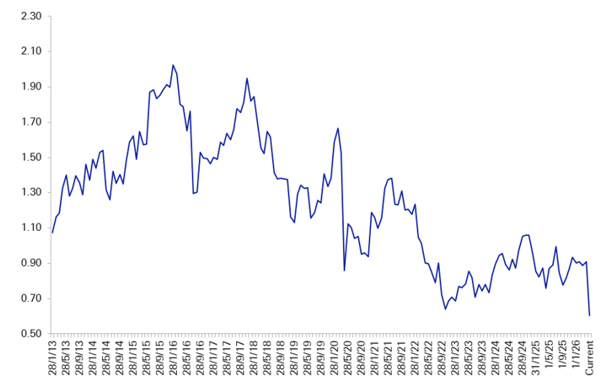
In a similar vein, we added to DFS, Kier, Whitbread, where the valuation picture is similar to Bellway on a price-to-book basis, and Lloyds.
Results year to date have been very strong from a dividend perspective. Both Barclays and Standard Chartered announced a step change in their dividends earlier than anticipated, with the HSBC dividend also being materially higher than expected. These changes have also improved our 2027 Fund dividend forecast.
Keller moved to a 3x payout ratio, which meant their final dividend rose 57% (vs our forecast of 15%). Glencore exceeded our forecasts materially, while several companies including GSK, Costain, Rathbones, and Forterra delivered marginal dividend upside that collectively had a material effect.
Partly offsetting this there were three stocks where dividends were lower than expected – PageGroup, Mondi, and Ibstock.
The net effect of all these changes was, however, positive.
At a market level, several large stocks that we do not own cut their dividends materially e.g. Diageo (down 50%) and WPP (down c.50%), which will have a drag on the wider index dividend growth level, so it is likely 2026 will be another year, where the Fund delivers a better dividend growth than its benchmark.
Our current Fund dividend growth guidance for 2026 is for a low single digit increase. We would normally, based on the results above, upgrade this at this point in the year. However, given the wider uncertainties created by the Iranian situation, we will defer consideration of this until the end of Q2.
For Q1 the Fund dividend rose by +30% - the main part of this, being a timing issue, rather than an underlying increase.
We have also, on a stock-by-stock basis, forecasted 2027 dividends for the first time. The initial look forward is very positive. We will again comment on this in more detail later this year.
The Fund dividend yield is 4.5% for 2026.
Prior to the war in Iran, we had expected interest rates to fall further in the UK in 2026 as inflation was likely to hit 2% during the early summer. However, the impact of higher energy prices and their related products will see inflation increase somewhat, particularly in July when the energy price cap will be re-set. In the short term, it is likely that consumers and households will exhibit caution around their spending plans. However, the duration of the conflict is difficult to assess, and wholesale structural changes to the Fund are unwarranted given the strong potential for a recovery in consumer activity, supported by years of accumulated savings. Furthermore, bond markets appear to have adopted an overly cautious view on future interest rates. Currently, markets assume an increase of around 75 basis points in short-term interest rates. This feels like a possible but unlikely outcome as the economy is in a very different place to where it was in 2022 when the Ukraine war started. Labour markets are less tight and supply chains are less stretched, meaning the transmission mechanism for a much higher pass through in inflationary pressures is more subdued. To be clear, we do expect inflation to rise, but if oil prices remain in the $100-110 range, this is more likely to translate into inflation of 3.5-4.5% rather than the 10-11% seen in 2022. In these circumstances, raising UK interest rates materially would probably be a policy error, although the risk of that happening cannot be ignored.
Historically, the strategy has often suffered underperformance in the initial days and weeks of a crisis but subsequently recovered as valuation support starts to kick in. For example, many of our banks and insurance holdings offer free cash flow yields of 14–16%. For banks, higher short-term rates would support near-term profitability, unless it triggered a significant impairment cycle. Elsewhere, we have many stocks trading on deep discounts to asset value. For example, the recently acquired Derwent London is valued at 50% of NAV despite its strong and well-let London property portfolio. We are not complacent about the risks of a drawn-out conflict in the Middle East, but typically these events tend to provide good opportunities to add to strong franchises and the Fund will continue to do that in a measured way. A cessation of hostilities could see a very sharp rebound in a number of stocks and sectors that have been heavily punished in the last month.
As we have written in recent months, the strength of UK private sector balance sheets, both households and corporates, continues to be under-appreciated by many investors, particularly international ones who are fed a lazy narrative by many parts of the media. Whilst activity levels will inevitably become more subdued in the coming weeks, any resolution could see a sharp snap back in activity and appetite and that is what we will continue to focus on as a central case. If the conflict drags on for longer than expected, the strong balance sheets of our companies and the very limited levels of leverage mean that, in general, value will not be materially eroded, but merely deferred. In the meantime, the portfolio yield is moving close to 5% on 2027 estimates and many stocks sit close to, or below asset value. We have no insight as to when this crisis will pass, but we will stick to doing what we have done for 20+ years — identifying materially undervalued businesses based upon their level of normalised earnings which have the potential to be rated more highly at some point in the future.


From shifting political dynamics to compelling stock opportunities, this month’s bulletin explores how the Fund is uncovering value across the UK market while delivering income and long-term growth potential.
Resilient markets and attractive valuations support a differentiated UK income strategy.
Senior Fund Managers James Lowen and Clive Beagles, together with Fund Manager Josh Herson, provided an update on how geopolitical developments, inflation trends, and interest‑rate dynamics are influencing equity markets and income opportunities.
Geopolitical shocks drive dislocation, widening valuation gaps across UK equities despite resilient underlying company fundamentals.
From our very first conversation to ongoing support, our teams of experts are here to answer your investment needs.