
JOHCM UK Dynamic Strategy
Size
GBP 496.74m

Those reflecting on 2025 may wonder how global equity markets reached new all-time highs amidst a backdrop of profound discontinuity. As we write, the leader of the free world continues to brazenly test the existing world order, yet equity markets remain serene. Many may fear these are sure signs of market complacency. However, the reality is considerably more nuanced. A careful examination of the forces shaping markets is essential to ensure that the investment opportunities we identify for clients are driven by fundamentals and not distorted by the crowd’s excessive and instinctive exuberance. In 2025, the S&P 500 total return index rose by an impressive 15%. Impressive not just because this was its third consecutive year of double-digit returns, but because this was supported by earnings growth of ~12%, the index’s strongest level of growth for 8 years (excluding COVID re-opening in 2021). The US economy is amid an AI-led investment cycle of unprecedented size, with hyper scaler capex growth set to excel further, this is likely to remain a dominant theme in 2026.
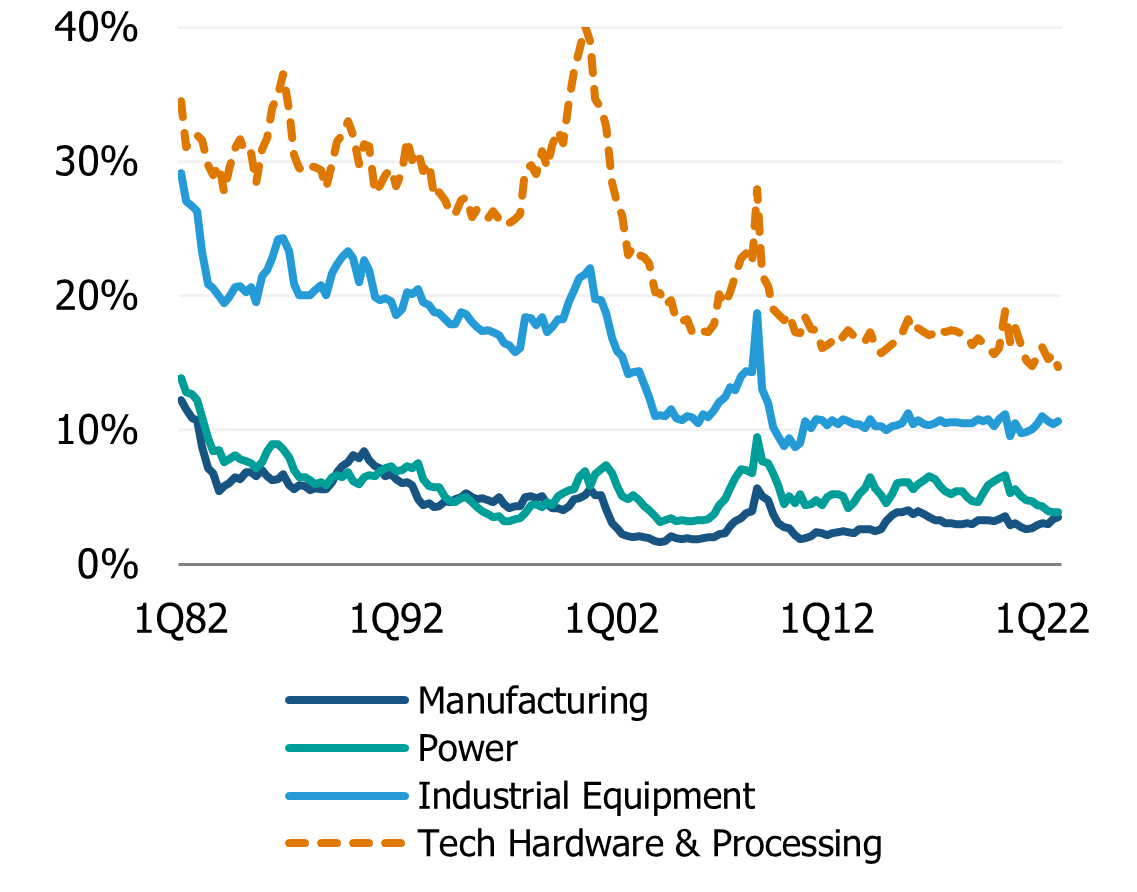
It is easy to forget that the US and other developed economies have not experienced a capex-led investment cycle for roughly a quarter of a century. While AI chip stocks have captured the spotlight in recent years, the more significant earnings uplift is likely to emerge further down the value chain, in power, manufacturing, and industrial equipment, following decades of underinvestment (Exhibit 1). Capacity constraints are already beginning to surface, with lead times for new natural gas turbines extending to around four years, and similar pressures likely to emerge across other industrial segments.
Exhibit 1: Areas of Underinvestment
US Sector Capex as a % of Pre-Tax Profits
Source: Bureau of Economic Analysis; JOHCM.
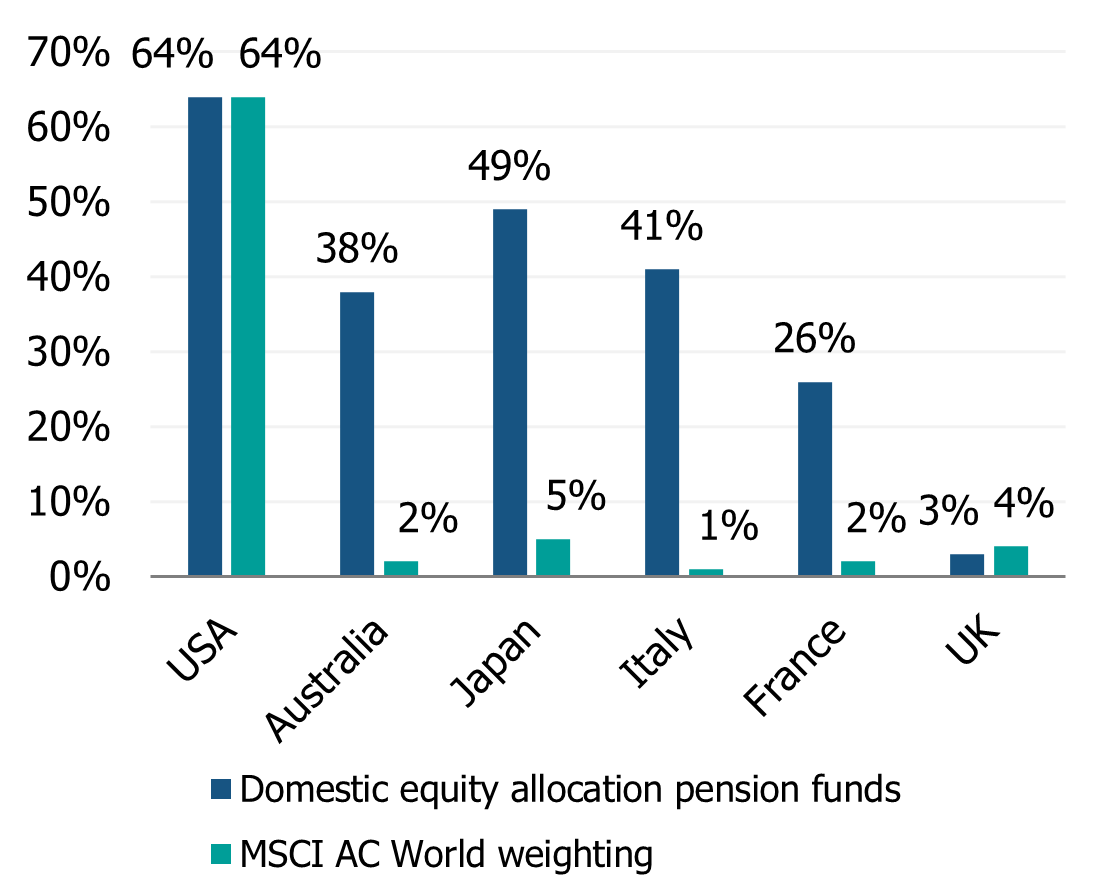
Although the capex cycle has been US-led, it was international stock markets that saw the most marked moves in 2025, dwarfing the rally in US indices. The FTSE All-Share Total Return was up a remarkable 33% in US dollar terms, clear evidence that the US exceptionalism trade cracked in 2025. Such outperformance underscores the importance of starting valuations when assessing future returns. The question now for investors, is how much further can these valuations go in 2026? The fundamentals and technicals suggest they can go higher still, especially in the UK. UK sector-adjusted P/Es remain at multi-decade lows relative to the US, while domestic pension funds are notably underweight compared with peers (Exhibit 2). This has constrained current ownership and increases the potential impact of any re-engagement. At the same time, returns have been highly concentrated, with 42% of the FTSE 100’s 2025 gains driven by just three stocks: HSBC, AstraZeneca, and Rolls-Royce.
Exhibit 2: Ample Room for Market Participation in the UK
Domestic Equity Exposure of Pension Funds vs Global Equity Market Weight
Source: Goldman Sachs Research, Marco Guide, October 2025, Liontrust, Factset 30.09.25, Aitken Advisory.
With a decade having passed since Brexit, 2025 saw a tentative return of international investor interest in UK assets. The noise and politics surrounding the Autumn Budget highlighted the fragility of the UK political environment, yet the outcome demonstrated that pragmatism can prevail over perceived risks. Polls show that Keir Starmer has the lowest personal approval rating of any prime minister since Thatcher in 1979. But, he is not alone. Voter support for governments has collapsed across major developed economies, including Denmark, Germany, France and the US. In fact, President Trump now ranks as the most unpopular president of all-time. Relative to many developed peers, the UK now appears unusually stable and with the lowest US tariff deal on offer, well positioned as a hub for international trade. Global-facing UK businesses will undoubtedly be in the M&A crosshairs in 2026 after what was another bumper year in 2025, despite the political uncertainties (~£35bn of UK public companies acquired). These are exactly the types of franchises the Fund has been adding to its holdings in the last two years.
Waning political support for governments is a consequence of rapid technological change and economic disruption. Slow moving “medieval” institutions have failed to keep pace with the speed of innovation and labour-market change. Thus, laws become outdated, companies fail to adapt and workers see limited income growth and worsening job security. The K-shaped economy, characterised by diverging outcomes across income and skill levels, was a major feature of 2025. The accelerating roll-out of “god-like technology” suggests this divergence is unlikely to change in 2026. From an investor perspective, this suggests continued pressure on consumer-facing stocks and, more worryingly, a higher risk of market dislocations as national politics become harder to predict.
While nominal incomes have risen, affordability pressures remain acute as essential costs continue to absorb a growing share of household budgets. Both Starmer and Trump have already made the cost of living a central focus for 2026, underscoring how politically acute the issue of household affordability has become. Attempts to lower interest rates will likely follow, with the aim of easing the financial burden on households and reducing debt-servicing pressures for governments. In the US alone, government debt is forecast to rise by $1tn over the next 100 days, according to Bank of America (Bank of America Global Research, The Flow Show — “Long Boom, Short Bubble”, 8 January 2025). Lower interest rates should be beneficial for asset prices. A lower cost of capital will accelerate the capex investment cycle and increase the valuations of longer duration assets. However, accelerating technological change and increasingly interventionist governments are likely to make market outcomes more uneven and episodic.
There are undoubtedly several attractive tailwinds for equities in 2026, especially in the UK, but there is also ever-growing uncertainty. As investors specialising in business transformations, these are risks that the JOHCM UK Dynamic team understand well. We seek to protect investors from more visible risks by investing only in businesses where cash flows are inflecting and a clear strategy exists to deliver recurring shareholder value. By contrast, it is the less observable risks that increasingly concern us. We mitigate these by identifying globally oriented, uncorrelated business transformation opportunities, supported by strong balance sheets and low market expectations.
Currently, 88% of the portfolio (excluding Financials) has net debt to EBITDA of less than 2.5x. The Fund’s three-year forward compound earnings growth is forecast at approximately 15%, alongside a free cash flow (FCF) yield of around 9%. This level of earnings growth is comparable to consensus forecasts for Microsoft, but at a free cash flow yield roughly three times higher and applied across a far more diverse and uncorrelated set of assets. We believe this represents an attractive proposition for investors, offering resilience against the rapid shift from exuberance to fear that often characterises market behaviour.
The Fund performed in-line with the FTSE All-Share benchmark in 2025 which was, pleasingly, a top quartile performance in what was a very tough market to outperform. The Fund often lags strong, broad, equity market rallies and hence it is notable that all gains attributed to stock selection in the period were equally offset by negative allocation effects. Continued operational momentum from key holdings should be a positive tailwind for the Fund in 2026.
A notable contributor was Johnson Matthey, where the gains more than offset the declines seen in 2024. It demonstrated the value that can be unlocked when a successful business transformation is accompanied by low market expectations. For Johnson Matthey, this equated to management announcing the sale of its Catalyst Technologies business for a price equal to 67% of its undisturbed market capitalization, while foregoing only 20% of the group’s profits. Rising commodity prices also boosted company earnings and cashflows resulting in a year of strong equity value creation. Our primary focus as investors, however, is forward-looking. The post disposal business, by our calculations, trades on a mid-teen free cashflow yield with no financial leverage, and that is before the transformational benefits of its brand-new platinum group metals (PGM) facility. The full commissioning of the new PGM processing operation has been delayed by around 12 months to mid-2027, reflecting the complexity of ramping it to full capacity. Highly regarded CFO Richard Pike has moved to the COO role and will have complete oversight of the project scheduling from hereon. We remain confident that market expectations do not yet reflect the improvements in operational performance and working capital expected once the operation is fully online.
The Funds’ key financial positions, namely Standard Chartered and Barclays, delivered a strong performance in 2025. Both companies are benefitting from focused and experienced leadership driving structural and cultural change through the organizations. In the case of Standard Chartered, via its ‘Fit for Growth’ cost program, and Barclays via its ‘Reshaping for Growth’ efficiency plan. These businesses are now much better capitalised, reporting core Tier 1 capital ratios of more than 14%, more than double pre-Global Financial Crisis levels. Importantly from an investors perspective, we are reassured that despite low loan delinquency rates, the strategy at both firms is to retain balance sheet strength and return excess capital to shareholders. The growth focus at Standard Chartered is going to be on higher-quality earnings streams, such as digital banking and wealth management in hubs like Singapore and the UAE. Whilst Barclays is prioritising a reduction in exposure to its lowest-returning division, the Investment Bank, to free capital for its higher-returning retail, corporate and wealth management units. Both businesses now trade at a premium to their tangible net asset values. We believe this is warranted given both now have established records of generating high returns and compounding book growth. The rapid adoption of AI across organizations opens a new pathway to sustainable organic growth and high teen returns on tangible equity, which we believe the current valuation fails to reflect.
For GSK, 2025 marked the first time in five years that Zantac litigation was not at the forefront of investors’ minds, although this was quickly replaced by concerns over potential US tariffs on pharmaceuticals. Now that these tariff concerns have come to pass, the debate has shifted to the credibility of long-term guidance and the strategic plan to pivot the business towards Speciality Medicines. Positive Phase 3 readouts for Blenrep, Penmenvy, Blujepa, and Nucala (COPD) support our conviction in the group’s 2031 sales guidance of over £41bn. Achieving that trajectory would, on our numbers, see underlying annualized free cashflow generation approach £10bn. Importantly, new CEO Luke Miels has reiterated commitment to the targets he inherited from outgoing CEO Emma Walmsley. A smooth leadership transition appears to have been welcomed by the investor community. The high margin of safety afforded by the double digit free-cash flow yield whilst returning over 5% of market capitalization via buybacks and dividends continues to provide an attractive risk-reward opportunity for our investors.
After repairing its balance sheet during the COVID-19 pandemic, Rolls-Royce finally achieved its targeted investment-grade rating from all three rating agencies in 2025, which completed the balance sheet transformation. However, a significant operational transformation has also been executed in tandem. The fortunes of the business have conclusively transitioned away from being primarily reliant on air-travel (civil aerospace). As we have discussed, geopolitical tensions are escalating, and that has reshaped the order backlog and earnings visibility for the Rolls-Royce Defence unit. Furthermore, as datacentre rollouts continue at pace in response to AI requirements, the grid infrastructure has come under intense pressure. This has boosted demand for backup power, where Rolls-Royce Power Systems holds a leading market position. In addition, the business also secured a landmark contract for its disruptive Small Modular Reactors (SMR) nuclear technology and announced a cost-effective re-entry into the narrowbody engine market. Simply put, there are multiple mega-trends that are set to drive earnings and cashflow at the company for the foreseeable future. Despite the sharp move in the share price, our conviction here continues to be supported by a mid-single digit underlying Free Cashflow Yield compounding at mid-teens, plus a healthy net cash balance.
It’s only been two years since Breon Corcoran, ex-Paddy Power Betfair, took the helm as CEO of IG Group, but it is safe to say a lot has already been accomplished. The group, which had lost its way under the prior management, has thrived under a rapid decentralisation of decision making. The UK product offering was enhanced through the launch of a new US options and futures proposition. Active customers more than doubled following the acquisition of Freetrade, underperforming growth initiatives were exited, and a new crypto offering was developed and launched, all while returning over £775mn to shareholders via dividends and buybacks. In addition, valuable stakes in Payward (parent of Kraken) and ZeroHash, each of which provide incremental strategic and financial flexibility, continue to be overlooked by the investor community. The company is also a natural beneficiary of rising volatility risk that is occurring worldwide. Shares currently trade at a near double-digit free cashflow yield, which implies the market believes cashflows will not grow. Given the initiatives in play across the organization, we believe the market’s assumption will prove to be too conservative.
Five years ago, in response to OFCOMs Wholesale Fixed Telecoms Market Review, BT Group’s then Chief Executive, Philip Jansen, announced his “build like fury” initiative – a commitment to roll-out full-fibre to over 20 million premises by the mid-2020s. His successor, Allison Kirkby, has not only insured delivery on that ambition but raised the target to 30mn households by 2030, implying near universal residential coverage. This is proving to be a strategic masterstroke as the market slowly acknowledges the value created by the multi-year network investment and the corresponding internal efficiency drive. Importantly, the fruits are becoming visible at a time when the competitor alternative-network sector has racked up over £13bn in debt. These “alt-nets” have managed 60% UK coverage but at a cost per home, which is nearly twice that of Openreach/BT and a take-up rate which is half that of the market leader. Per Berenberg estimates, alt-net take-up rates need to double just for the sector to break-even post interest payments. Unsurprisingly, the sector is consolidating, primarily with a focus on balance sheet repair and cash generation. This suits BT, where CAPEX has already peaked and is expected to fall by £1bn in the next financial year. BT is also increasingly on the right side of the AI trade, using proprietary tools to underpin network optimisation, halving resolution times by adoption of conversational platforms and servicing AI workloads with edge data centres. The groups’ target of £3bn of annualized free-cash flow by 2030 now looks firmly within sight. In other words, high-teens free-cash flow yield for a well-invested, clear market share leader.
WPP capped off its fall from grace by cutting its dividend and dropping out of the FTSE 100 in 2025. A market capitalization that had once peaked at £24bn, now stands just shy of £4bn. Global AI adoption is accelerating, and agencies sit squarely in the firing line. If agencies are to survive, they will need to shift to outcomes-based pricing which will require a rapid change in strategy and culture. This is not lost on the recently appointed Chairman, Philip Jansen, who has proved his ability to successfully execute transformations, whilst at BT Group. His newly appointed CEO, Cindy Rose, is also a high-calibre tech executive (from Microsoft) with the right prerequisites for championing an AI-led turnaround through WPP’s existing AI-platform, WPP Open.
There are early signs of improvement at WPP, reflected in major client wins such as Mastercard and the UK Government. However, these gains have so far been more than offset by the loss of legacy accounts, primarily to Publicis. It is important to note that the current revenue per employee at Publicis is over 25% higher than WPP. While both organizations have their own intricacies, this does in our view, provide a flavour of the operational turnaround opportunity at WPP. We anticipate efficiency initiatives will be supplemented by non-core asset and brand optimisation, potentially paving the way for material equity recovery and value creation. Purely reversing the cumulative working capital consumption in the firm over the past four years would nearly half the net debt and inflect the underlying cash generation. Meanwhile, with a free cash flow yield approaching 20%, we believe the company is priced for failure, skewing the risk-reward firmly in our favour.
The other subset of performance detraction came mainly from the non-ownership of index heavyweights, namely AstraZeneca, British American Tobacco, BAE Systems, Lloyds and Natwest. This should not be entirely unexpected for a concentrated portfolio of between 35 to 40 names in a market which was up 24% in absolute terms. Our investment process focusses on business transformations, where levers are being actively pulled to unlock recurring equity value. In our view, these names lack the idiosyncratic drivers of returns and clear levers of change we require to support our conviction.
The Fund completed another year of highly active idea rotation with seven new ideas entering the portfolio and ten exits. In Q4, there were two new additions and two exits.
A starter position was initiated in a leading sustainable water and climate solution business, Genuit. The business generates 90% of revenue from the residential, commercial, and infrastructure sectors in the UK where volumes have been subdued, driving the share price to multi-year relative lows. Management have implemented a group-wide, lean transformation program to create a culture of continuous improvement and drive medium-term operating margins sustainably above 20%. In our view, the market is overlooking the permanent efficiency gains being made, which should provide significant operating leverage as and when volumes normalise. This is before considering regulatory tailwinds such as Awaab’s Law, effective from 2025, which requires social landlords to remediate damp and mould hazards, and the Future Homes Standard, which mandates that new UK homes achieve 75–80% lower carbon emissions. Even excluding these factors, we believe the business can generate £100mn of free cash flow per annum by 2030. This would imply a near double-digit underlying free cash flow yield for a market leader with a strong balance sheet. We also initiated a base position in Jet2, the UK’s largest tour operator and third-largest airline, where management is pulling multiple operational improvement levers and the announced entry into London Gatwick has the potential to be transformational. The group’s vertically integrated model from 13 bases already has coverage of >70% of the UK, but this will increase significantly with the addition of Gatwick. Passenger throughput at Gatwick could easily surpass Manchester Airport, currently their largest base. Earnings tailwinds should also come from the fleet being transitioned to Airbus A321 Neos, generating an estimated £10 cost saving per seat and a 20% reduction in fuel consumption. Currently, Jet2 achieves just £20 of operating profit per sector seat. In addition, the recently implemented Retail Operations Centre (ROC) is ensuring 99% stock availability, contributing handsomely to high-margin ancillary revenues. By harnessing AI and machine learning, the group is enhancing its dynamic pricing and optimising profitability across 250 million holiday permutations. At the same time, the business is being run prudently. Even excluding client monies, the group is net cash. This balance sheet is a critical strategic asset, providing the flexibility to navigate any downturn, be tactical on price, and invest when rivals are balance sheet constrained.
Finally, we exited our remaining positions in Smiths Group and Elementis. Announcement of the sale of Detection Systems to CVC, at a valuation in-line with our expectations, marked completion of the sum-of-the-parts value unlock story for the investment case at Smiths Group. Likewise, completion of the operational turnaround, combined with a more subdued top-line performance at Elementis, left no further upside to our investment thesis.
There is clear evidence of strong operational momentum in the Fund’s key, high conviction positions, supporting our forecasts of ~15% compound earnings growth for the portfolio over the next three years. However, share prices and valuations begin 2026 much higher than they did in 2025 both in the UK and across the globe. These challenging comparators suggest markets could be volatile in 2026 but, underneath this, strong drivers exist for equities to re-rate further, especially in the UK, as evidenced by the Fund’s ~9% FCF yield. Clear pockets of value remain, such as in UK mid-caps, where the Fund has a multi-year high allocation. The FTSE 250 has now underperformed the FTSE 100 for four consecutive years.
We are optimistic about the Fund’s outlook in 2026 and continue to believe focusing on high conviction business transformations with an identifiable margin of safety and strong balance sheets is the best way to generate sustainable returns for our investors. Combining these to form a low correlation, low beta (~1) portfolio should further enhance this risk/reward.
We thank you for your support and look forward to updating you over the year.


As uncertainty rises and AI reshapes markets, where are opportunities emerging? Explore how a transformation-driven approach uncovers mispricing and long-term advantage in complex markets.
Fund Managers Vishal Bhatia and Tom Matthews discussed how increasingly “black and white” equity markets- where capital is concentrating in a narrow group of companies—are creating a broader opportunity set for active investors. They reviewed first‑quarter performance and highlighted business transformation opportunities that have the potential to unlock recurring shareholder value.
Explore key insights from the UK Dynamic Quarterly Update, covering portfolio positioning, shifting sentiment, and resilient stock selection amid uncertainty.
A review of 2025’s equity resilience and what shifting fundamentals, valuations, and politics mean for markets in 2026.
From our very first conversation to ongoing support, our teams of experts are here to answer your investment needs.