JOHCM UK Dynamic Strategy
Size
GBP 496.74m
In many ways, a review of Q1 2026 is an exercise in humility. As investors, admitting what you do not know is often just as important as identifying what you do. After all, conviction is about weighing probabilities as opposed to successfully predicting the future. Success instead comes from consistently identifying where those probabilities are tilted in your favour.
Global economic developments in 2026 have served as a sharp reminder that there is often more we do not know than we do. Uncertainty is on the rise. But for long-term investors, this is not necessarily a bad thing. Rising uncertainty can lead to more visible market inefficiencies. As business transformation investors with an approach grounded in the reality of uncertainty these are exactly the market conditions in which this fund’s process is designed to perform well.
Geopolitics, technology, society, and capital markets are all changing at a rapid pace. With recent news flow dominated by the Iran conflict, it is easy to miss that the global capex cycle – the first in 25 years Under the Bonnet: 2025 Recap and 2026 Outlook – continues to accelerate. Hyperscaler capex forecasts were upgraded again in Q1, with Google and Amazon now set to spend close to $200bn each in 2026 alone. For context, this is equivalent to each of them building over 2x mining conglomerate Rio Tinto’s net tangible assets in a single year.
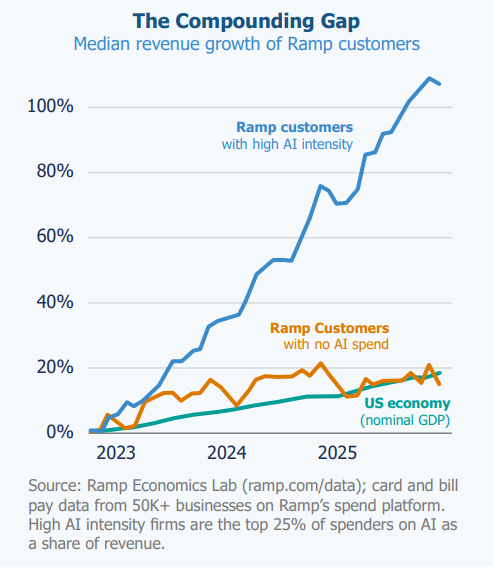
Importantly, it is not just AI spending that is on the rise, but also the evidence of success in AI adoption. Analysis from Ramp, with data from over 50,000 businesses, shows that revenues of high-intensity AI spenders have doubled since 2023 – five times the pace of the wider US economy. Companies are also increasingly demonstrating AI’s tangible benefits, leading to a visible acceleration in structural efficiencies. Rolls-Royce and Barclays were two notable examples here for the Fund in Q1. This rising capex, combined with rapid technological change, will undoubtedly lead to positive tailwinds for early adopters and for those building AI’s supporting energy and industrial infrastructure. On the flip side, the shape and scope of potential negative AI impacts remain unclear, including the physical constraints of large-scale deployment and the broader effects on companies and society.
The so-called ‘SaaS-mageddon’ in Q1 was the market’s attempt to price some of these unknowns. Although there were clear signs of oversimplification, including companies basketed into ‘AI winners’ or ‘AI losers’, a look at the breadth of sectors affected is insightful.
Given the accelerating pace of innovation, it is appropriate to question enterprise valuations in an increasingly wide range of sectors. For example, AI disruption of the legal services market was only a matter of time, in our opinion, yet the valuations of companies like RELX did not provide any headroom for this uncertainty. What is interesting to us is where the market has been firmly convinced that a business is an AI loser, sometimes irrespective of mixed evidence or compelling information to the contrary. Plugging in generous assumptions (RELX, LSEG) leaves little margin for error; conversely, where the market has already priced in low expectations, the risk-reward ratio can potentially be tilted significantly in our favour (WPP, Pearson). Terminal values - the portion of a company’s valuation tied to its long-term forecast - really matter. In times of disruptive innovation, we need a clear margin of safety to accompany any long-term assumptions to reflect what cannot be known with certainty.
Beyond technology, the war in Iran has introduced a new layer of complexity. Even if a ceasefire is reached, the long-term implications are already set. On one hand, companies are better prepared to weather this disruption due to lessons learned from COVID-19 and Ukraine. On the other, the resulting energy shock, inflation, and higher bond yields create fresh headwinds, particularly for governments entering these events with record-high debt ratios. This is before we consider the need for greater energy security, supply chain resilience, reshoring, critical minerals security, and defence, which will only act as further accelerants of the global capex cycle.
In our view, all these changes are becoming increasingly interconnected. This is creating ‘deep uncertainty’ – a concept from complexity science describing situations where interacting crises produce outcomes that strain human comprehension. While we have no crystal ball, we are acutely aware that the breadth of possible outcomes is increasing which means we must remain disciplined as investors.
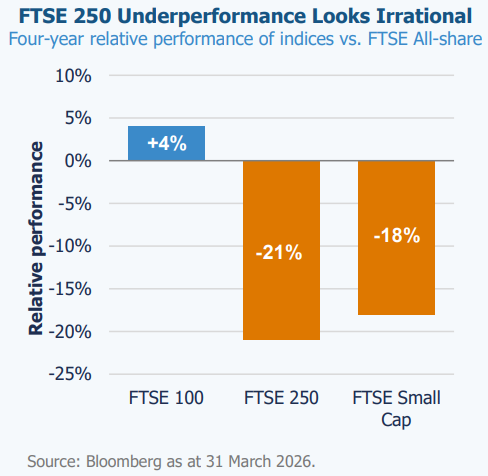
First, we must be wary of oversimplifications such as AI winners/losers, GLP-1 winners/losers, or HALO (Heavy Assets Low Obsolescence) classifications. To be drawn into these binaries, risks succumbing to behavioural biases such as motivated reasoning and self-serving bias. Instead, stepping back to observe how these narratives are taking hold can help highlight where potential market inefficiencies may be emerging. In this context, the continued underperformance of the FTSE 250 is a curious anomaly, and the Fund continues to be overweight. Whilst its underperformance versus the FTSE 100 can be rationalised on the grounds of liquidity (albeit not its scale) those same arguments do not hold when we consider it has also underperformed the FTSE Small-cap index (see below). Reality is beginning to look warped.
Second, we must be wary when share prices no longer reflect a company’s likely future cashflows. Valuation matters, both on the upside and on the downside. In uncertain times, this fundamental premise of public markets is easily forgotten. We must actively recycle capital to where the risk-reward is firmly tilted in our favour. Currently, the Fund trades on a 9% free cashflow yield (ex. Financials) and represents a diverse set of companies where experienced management teams have idiosyncratic levers to unlock embedded equity value. With the Fund’s beta (ex-ante) at just 0.9 and 91% of the holdings (ex. Financials) having a net debt to EBITDA of less than 2.5x, we have the quantitative evidence that the Fund’s margin of safety is robust.
Finally, we must be wary of the rise in tail risks –the “unknown unknowns.” A structural advantage of operating in the UK market is it represents what we refer to as the “Costco of global equities”. The Costco model is built on providing high-quality products at low prices, typically in bulk. The Fund seeks to mitigate unobservable risks with a similar approach: securing high conviction positions in globally-orientated, uncorrelated business transformations that are supported by strong balance sheets, while trading at valuations that are a significant discount to global peers.
It is the combination of these qualitative and quantitative characteristics that have positioned the Fund to perform well in the recent environment, underpinned by an investment approach coloured by the reality of uncertainty.
The Fund’s largest contributor in the period was FTSE 100 group Beazley, a speciality insurance underwriter, with strong positions in niche lines including cyber, marine, property and professional indemnity. In January, the company received an all-cash offer from industry peer Zurich Insurance Group. The recommended transaction, which we supported, creates a world leading speciality underwriter with combined gross premiums of more than $15bn per annum. Prior to the approach, Beazley was yet another example of a global player available on the UK stock market at a discount rating relative to its prospects. The company had generated an average return on equity of 25% since 2022, had a strong balance sheet with 264% solvency capital and had returned over $1.3bn to shareholders over the past three years. Yet it traded on just 1.6X its growing tangible net asset value, a 60% discount to its eventual take-out offer of 2.4X. Beazley is a blueprint for a core UK Dynamic investment – a global leader with a high margin of safety where an experienced management team is pulling levers to create recurring equity value.
The Iran-centred escalation in geopolitical conflict has pushed energy security to the centre of UK government’s policy agenda. In public remarks, Sir Keir Starmer has tied the Iran shock directly to the case for “clean, homegrown British energy” and overall “energy independence.” Centrica is investing billions in renewables, LNG storage, regasification capacity and nuclear and the company is ideally placed to be a vital private partner for the government if it wants to achieve its long-term energy market aspirations. Furthermore, a transformation programme that will target reducing the groups £1bn+ technology and support costs by continuously automating repetitive tasks by AI-led solutions is well underway. The group has a net cash balance sheet and a double-digit free cash flow yield, alongside a strategic plan to double EPS and increase regulated and contracted earnings to over two-thirds of the group by the end of the decade. Hence, despite a strong performance in the first quarter, we retain a conviction position in the shares.
Our annual visit to the Mobile World Congress in Barcelona highlighted the importance of dense fibre networks as the foundational infrastructure for reliable, secure, low-latency connectivity that is imperative to enable AI-native services. Within the UK, Openreach’s £5bn full-fibre expansion program to cover over 30m households with a market leading take-up rate of 38% has extended BT’s fixed access infrastructure leadership. More impressively, this has been done whilst simultaneously completing non-core asset disposals in their international operations and achieving sustainable cost transformation with energy usage, labour resource, and repair volumes down 6%, 7%, and 18% respectively. The business is enroute to £2bn cash generation per annum in the next fiscal year, which will accelerate the debt-to-equity transfer in a group which, despite recent strength, still trades on a double digit free cashflow yield. We are retaining our conviction position.
Glanbia, a protein powerhouse that includes the world number 1 sports brand Optimum nutrition, announced a solid set of results despite rising cost inflation driven by record whey prices. We initiated this position in May last year after drawing conviction in the group-wide transformation program to simplify the business, generate procurement savings, improve marketing efficiency, and address the historical conglomerate discount through the divisional separation of Dairy Nutrition and a focused disposal program. It is sufficient to say that we have seen progress on all these management initiatives, and the market has rewarded the company for this execution. A free cashflow yield which was over double-digits has now re-rated to around 7%. Whilst we remain confident of further equity value unlock here, we have pared back our position somewhat to reflect the reduced margin of safety.
While stock selection delivered positive gains, these were offset by allocation headwinds in the Consumer Discretionary and Energy sectors.
Anthropics’ launch of a Claude desktop agent extending agentic AI capabilities to non-technical users led to intense pressure on software stocks, which witnessed the worst quarterly decline since 2008. In this environment, despite being firmly at the forefront of AI disintermediation concerns ever since the launch of ChatGPT in late 2023, shares in marketing agency WPP struggled to find a floor. In the process, the market wrote off any potential traction from the operational initiatives announced by new CEO Cindy Rose at the capital markets day event held in February. The “Elevate28” transformation strategy will see the company transition to a simple, low-cost, AI-enabled business using the data capabilities of their agentic marketing platform, WPP Open. As part of this approximately £500mn of gross savings are being targeted, which amounts to 20% of the groups’ current market capitalization. Management also aspires to deliver this transformation whilst retaining an investment-grade balance sheet, which in our view implies disposal of non-core brands and a reversal of the persistent working capital outflows. It is also important to note that peers like Omnicom and Publicis are growing their revenues at mid-single digits organically, highlighting there is business to be won for the strategically well-positioned. With WPP’s free cashflow yield now approaching 25%, multiple director purchases in the past six months, and a clear mandate for accelerated internal change, we believe the risk-reward is in our favour.
Diageo’s negative performance contribution in Q1 was primarily driven by the market reaction to the February dividend rebasing (targeting a 30-50% payout ratio). While the crowd viewed this as a guidance retreat, we interpret it as a prudent move to create a margin of safety for the equity as the business undergoes a thorough strategic review under the guidance of Sir Dave Lewis. Details of this will be announced late summer. In the interim, we are encouraged by the departure from yield management in favour of accelerated deleveraging and balance sheet flexibility - essential prerequisites for navigating deep uncertainty. In addition, significant self-help levers are already being pulled. These include the $2.3 billion disposal of the East African Breweries stake to Asahi and the sale of the RCB IPL franchise stake to a consortium of investors for estimated net proceeds of ~$800mn. Together, these actions simplify the geographic footprint, address part of the non-core portfolio, and reduce financial gearing. Despite muted H1 organic sales in North America and China, our thesis is supported by management’s reiteration of the $3 billion free cashflow target and the ‘Accelerate’ program, which seeks $625 million in structural savings. A high single digit free cashflow yield, and profit multiples at a generational low - we believe the market is mispricing a leading global franchise at the inception of a multi-year transformation.
The other subset of underperformance came from the non-ownership of index heavyweights namely Glencore, AstraZeneca and BAE Systems. These positions reflect our preference for idiosyncratic transformations over companies where the equity performance is primarily dictated by exogenous commodity cycles or geopolitical narratives.
Q1 was another period of active recycling of capital away from the mature transformations (Beazley) or where the strategic evolution has been underwhelming (Mony, Dowlais) into our healthy new idea pipeline (Victrex, AB Dynamics, Vanquis), as we ensure the portfolio remains weighted toward idiosyncratic alpha. We continue to prioritize businesses where we believe the margin of safety is significant and the value unlock from pulling the available internal levers of change is being overlooked.
Victrex is a leading global manufacturer of high-performance polymers servicing key end-markets including automotive, aerospace, energy, medical, electronics, and industrials. Over 90% of the company’s sales come from outside the UK. However, following a period of cyclical destocking, subdued volume growth and intensifying Chinese competition the shares have fallen to multi-year lows. Under the new leadership of Dr. James Routh who took charge on the 1st of January 2026, the business is pivoting from being a pure material supplier to a high-value solutions provider. A “Profit Improvement Plan” has also been launched, which targets over £10m in annualized savings by 2027. A near 10% free cashflow yield coupled with low financial leverage provides a high margin of safety and significant strategic optionality. We are looking forward to our meetings with the new management once they have had a proper chance to assess the current direction of travel.
AB Dynamics is a leading supplier for advanced testing, simulation, and measurement products to the R&D and testing functions of automotive majors. UK represents a small minority of overall sales reflecting its global customer base. The company is powertrain agnostic and a beneficiary of the increasing regulatory mandates in vehicle safety and autonomous systems. Once a “fans favourite”, shares have halved over five years largely due to macroeconomic volatility that has impacted revenue growth and an unexpected CEO transition. The business has ~£39mn in net cash and a free cashflow yield of approximately 7% providing a high margin of safety. In addition, the recent announcement of seasoned executive Andrew Lewis as the interim CFO gives us strong grounds for optimism given the significant operational turnaround achieved at Chemring Plc under his stewardship.
We initiated a position in Vanquis Banking Group following what we consider a generational overhaul of the leadership team. The appointments of Ian McLaughlin (CEO) and Dave Watts (CFO), veterans of NatWest and HSBC, respectively, along with Sir Peter Estlin (Chairman), who brings 35 years of experience in banking and finance, mark a step-change in management quality. The business focuses on credit cards, unsecured personal loans, and vehicle finance and is expanding into second-charge mortgages. The completion of the ‘Gateway’ project and the recent implementation of a single customer view are transformative, as only 15% of clients hold more than one product. We are also excited by the integration of the open-banking app Snoop, which we view as a hidden asset for low-cost customer acquisition. In a world of PPC (Pay-Per-Click) inflation, Vanquis is utilizing AI to pivot away from expensive third-party brokers (costing £46 per customer acquisition) towards direct leads at just 20% of the cost. The group trades on a high-teen discount to book value, with a strong balance sheet (core tier 1 of 16%+) and a target to deliver mid-teen ROTE sustainably by 2027. This provides a high margin of safety and meaningful upside optionality if the transformation is well executed.
After holding Mony for over a decade, we made the difficult decision to exit. Whilst we appreciate the extensive effort done to overhaul their data warehouse and launch the SuperSaveClub successfully, we are concerned by the direction of travel in the PPC (Pay-Per-Click) market. Our exit reflects the deep uncertainty surrounding AI’s structural impact on search. We believe AI is lowering the barriers for new entrants, leading to increased keyword competition at a time when Google is continually adjusting its monetisation models. Furthermore, the splintering of search across multiple AI platforms (Gemini, ChatGPT, Perplexity) necessitates higher spending to maintain a “share of eyeballs,” a dynamic that risks eroding margins diluting the groups’ internal efficiency drive.


As uncertainty rises and AI reshapes markets, where are opportunities emerging? Explore how a transformation-driven approach uncovers mispricing and long-term advantage in complex markets.
Fund Managers Vishal Bhatia and Tom Matthews discussed how increasingly “black and white” equity markets- where capital is concentrating in a narrow group of companies—are creating a broader opportunity set for active investors. They reviewed first‑quarter performance and highlighted business transformation opportunities that have the potential to unlock recurring shareholder value.
Explore key insights from the UK Dynamic Quarterly Update, covering portfolio positioning, shifting sentiment, and resilient stock selection amid uncertainty.
A review of 2025’s equity resilience and what shifting fundamentals, valuations, and politics mean for markets in 2026.
From our very first conversation to ongoing support, our teams of experts are here to answer your investment needs.